Patient Guide · Orthodontics
Types of Braces — What's the Difference?
Not all braces are the same. At The Tooth Stop we offer four types of fixed braces — each with a different balance of cost, aesthetics, and efficiency. Here is what you need to know to have an informed conversation at your consultation.
All four types of braces work on the same principle: brackets bonded to your teeth guide each tooth along an archwire until the desired position is reached. What differs is the bracket material (metal vs. ceramic) and the tie mechanism (elastic ligatures vs. a built-in self-ligating clip). These two variables determine how the appliance looks, how often you need to visit, and how much it costs.
Conventional Metal Braces
Most economical · Time-tested
The original and most widely used orthodontic appliance. Stainless steel brackets are bonded to each tooth and connected by an archwire held in place with small elastic ties (ligatures). Dr. P Meghana and the team manually adjust the wire tension at each visit — typically every 4–6 weeks — to progressively move your teeth.
Advantages
- Most affordable braces option
- Highly effective for all levels of complexity, including severe crowding and bite issues
- Brackets are small, smooth, and well-tolerated
- Coloured ligatures available — popular with younger patients
- Reliable in the hands of an experienced orthodontist
Points to note
- Most visible option — brackets and wire are clearly seen
- Elastic ties can stain between appointments (coffee, turmeric, etc.)
- Regular 4–6 week adjustment visits required
- Mild soreness after each adjustment is common
Self-Ligating Metal Braces
Efficient · Fewer visits
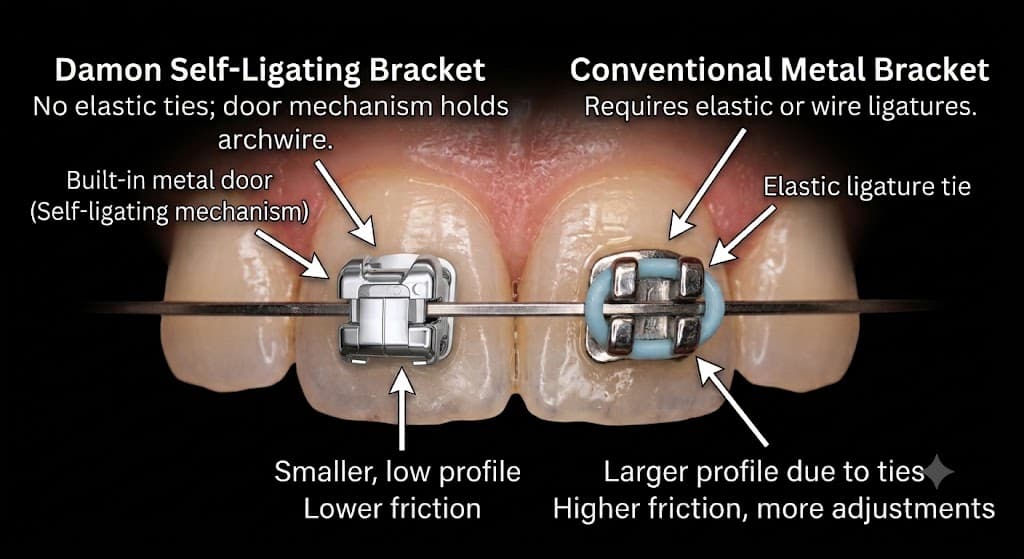
Left: Damon self-ligating bracket — built-in metal door, no elastic tie, smaller profile. Right: conventional metal bracket — elastic ligature tie, slightly larger profile, higher friction.
A modern evolution of conventional braces. Instead of elastic ties, the bracket has a built-in sliding door or clip that holds the wire. This reduces friction between the wire and the bracket, allowing the wire to move more freely as teeth shift. The result is often gentler forces on teeth and fewer clinic visits, since the mechanism does not need replacement at every appointment.
Advantages
- Fewer adjustment appointments — visits are typically every 6–8 weeks
- Lower friction can mean faster tooth movement in some cases
- No elastic ties, so no staining between visits
- Comfortable — gentle, continuous force rather than large periodic adjustments
- Suitable for all complexity levels
Points to note
- Higher cost than conventional metal braces
- Still visible — metal brackets and wire
- The efficiency advantage varies by case; not universally faster for every patient
Ceramic Braces
Discreet · Tooth-coloured
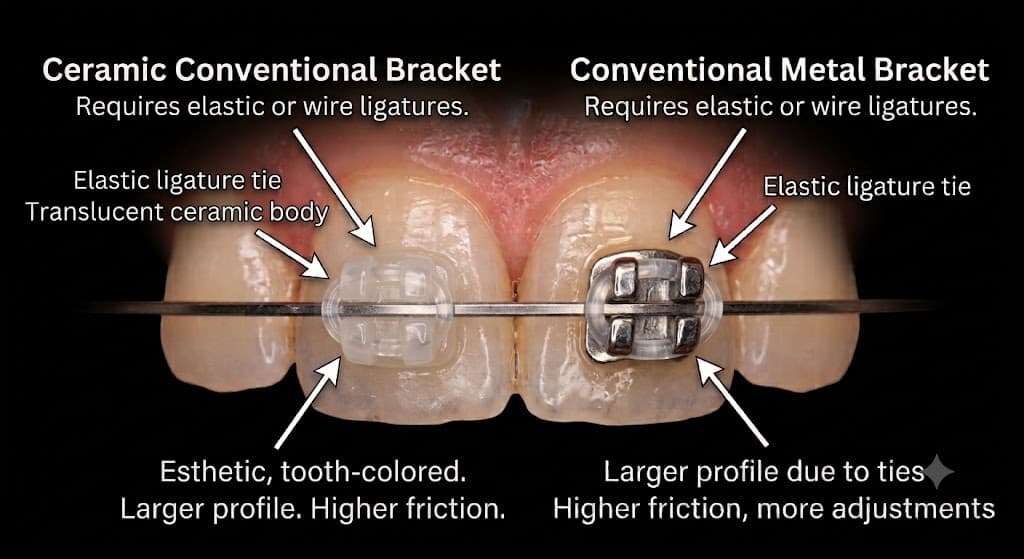
Left: ceramic conventional bracket — translucent ceramic body, elastic tie, tooth-coloured and discreet. Right: conventional metal bracket — same elastic tie mechanism, but clearly visible stainless steel.
Ceramic brackets are made from a tooth-coloured or clear polycrystalline ceramic material, making them far less visible than metal. They work identically to conventional metal braces — elastic ties hold the wire to the bracket — but the ceramic blends with the natural colour of your teeth, making the appliance much less noticeable in day-to-day life and photographs.
Advantages
- Significantly less visible than metal braces
- Ceramic material resists staining from most foods
- Brackets are smooth and comfortable against the lips and cheeks
- Equally effective as metal for the full range of cases
- Popular with working adults who want a discreet option
Points to note
- More expensive than metal braces
- Elastic ties (ligatures) can stain — the wire and ties may become noticeable over time
- Ceramic brackets are slightly more brittle than metal — patients with very strong biting forces need to be cautious
- Regular 4–6 week adjustments required, same as conventional metal
Ceramic Self-Ligating Braces
Discreet + efficient
The highest-aesthetic fixed brace option at The Tooth Stop. Ceramic self-ligating brackets combine the tooth-coloured appearance of ceramic brackets with the built-in sliding clip mechanism of self-ligating braces — eliminating both the visibility of metal and the staining issue of elastic ties. The result is a brace that is barely noticeable and requires fewer clinic visits.
Advantages
- Most discreet fixed brace option — tooth-coloured brackets, no visible elastic ties
- Fewer appointments than conventional braces (every 6–8 weeks)
- No ligature staining — clip mechanism keeps a clean look throughout treatment
- Gentle, low-friction forces — comfortable for most patients
- Excellent choice for adult patients who want minimal impact on appearance
Points to note
- Highest cost among the fixed brace options
- Wire may still be visible when close up
- Ceramic brackets are slightly more fragile than metal — requires some dietary care (avoid very hard foods)
At a glance
| Type | Visibility | Ligature | Visit frequency | Cost |
|---|---|---|---|---|
| Conventional Metal | Most visible | Elastic tie | Every 4–6 wks | Lowest |
| Self-Ligating Metal | Visible | Built-in clip | Every 6–8 wks | Moderate |
| Ceramic | Discreet | Elastic tie | Every 4–6 wks | Moderate–high |
| Ceramic Self-Ligating | Most discreet | Built-in clip | Every 6–8 wks | Highest |
Brands we use
Damon
Self-ligating system; one of the most widely researched SL brackets worldwide
American Orthodontics
Broad range of conventional and self-ligating brackets
3M
High-quality conventional and ceramic brackets
Metro
Reliable and cost-effective option
The brand recommended for your case depends on the type of brace you choose and the complexity of your treatment. Dr. P Meghana will walk you through the options at your consultation.
Which should you choose?
The right brace depends on you
Cost and aesthetics are factors, but they are not the only ones. The choice of brace type is also a clinical decision — and sometimes the treatment plan itself points to a specific type regardless of budget or appearance preference.
A good example is borderline extraction cases. When a patient is on the line between needing a tooth extraction and not, the reduced friction of a self-ligating system can make a real difference. Self-ligating braces allow the archwire to slide more freely through the bracket, which can help the teeth align and the arch to develop with less force — sometimes resolving mild crowding that might otherwise have required an extraction. In these cases, choosing self-ligating braces is not about convenience or aesthetics; it is the clinically better-suited appliance for that particular treatment plan.
Beyond extraction decisions, case complexity shapes the recommendation in other ways too — the degree of crowding, the type of bite issue, how much anchorage control is needed, and how the teeth are expected to move all factor into which bracket system gives the most predictable result.
Cost and visibility are real considerations and we always discuss them openly. But the starting point is always the case itself. Dr. P Meghana will review your X-rays and clinical photographs and recommend the type of brace that is the best fit for your treatment plan — and then walk you through the options within that recommendation so you can make an informed choice.
Not sure which braces are right for you?
Book a consultation with Dr. P Meghana at The Tooth Stop, BTM Layout. We'll review your case, show you what the options look like, and give you a clear cost estimate — no pressure, no jargon.