Patient Guide · Restorative Dentistry
Types of Dental Crowns — What's the Difference?
Not all crowns are the same material or made the same way. Dr Meghana and team at The Tooth Stop offer DMLS metal crowns, PFM crowns, and zirconia crowns — each suited to different clinical situations. Here is what you need to know before your consultation.
A dental crown is a cap cemented over a prepared tooth to restore its shape, strength, and appearance. What differs between crown types is the material (metal vs. ceramic vs. combination) and the manufacturing method (cast metal, laser-sintered metal, or CAD/CAM milled ceramic). These determine how the crown looks, how strong it is, and which tooth it is best suited to.
DMLS Metal Crown
Direct Metal Laser Sintering · Strongest fit
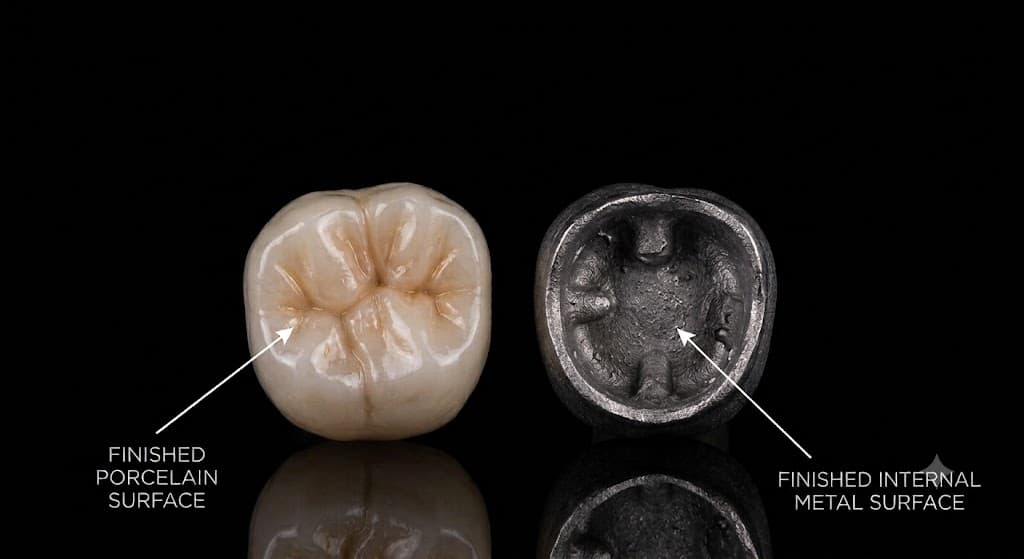
DMLS (Direct Metal Laser Sintering) is a precision manufacturing process where a metal crown or coping is built layer by layer using a laser to fuse metal powder. Unlike traditional casting, which can introduce small inaccuracies, DMLS produces a substructure with an exceptionally accurate marginal fit — meaning the edge where the crown meets the tooth is precisely sealed, reducing the risk of microleakage and secondary decay over time. The result is a full metal crown with exceptional strength and longevity, particularly suited to high-load areas where aesthetics are less of a concern.
Advantages
- Extremely precise fit — DMLS manufacturing eliminates casting shrinkage errors
- Highest strength — metal withstands heavy biting and grinding forces
- Very thin margins possible — minimal tooth removal required
- Long-lasting: metal crowns rarely fracture or chip
- Ideal for posterior (back) teeth where appearance is less critical
Points to note
- Metallic appearance — not suitable where the crown will be visible when smiling
- Some patients have concerns about metal allergy (rare, but worth discussing)
- Not the right choice for front teeth or for patients who want a natural look
PFM Crown
Porcelain Fused to Metal · Strength + aesthetics
A PFM (Porcelain Fused to Metal) crown combines a metal substructure — which can be cast or DMLS-fabricated — with a layer of tooth-coloured porcelain fused over it. The metal core provides the structural strength, while the porcelain outer layer mimics the colour and translucency of a natural tooth. PFM has been the workhorse crown of dentistry for decades and remains a reliable, cost-effective option for both front and back teeth that need a balance of strength and aesthetics.
Advantages
- Tooth-coloured appearance — suitable for front and back teeth
- Strong metal substructure handles occlusal (biting) forces well
- Proven long-term track record in clinical use
- More affordable than full zirconia crowns
- Good option when a metal base is clinically preferred but aesthetics still matter
Points to note
- Metal margin: a thin grey-black line may appear at the gumline over time, especially if gums recede
- Porcelain layer can chip under very heavy forces
- Less translucent than all-ceramic options — may look slightly opaque compared to natural teeth
- Not ideal for patients with metal sensitivities
Zirconia Crown
Full ceramic · Best aesthetics · Highly biocompatible
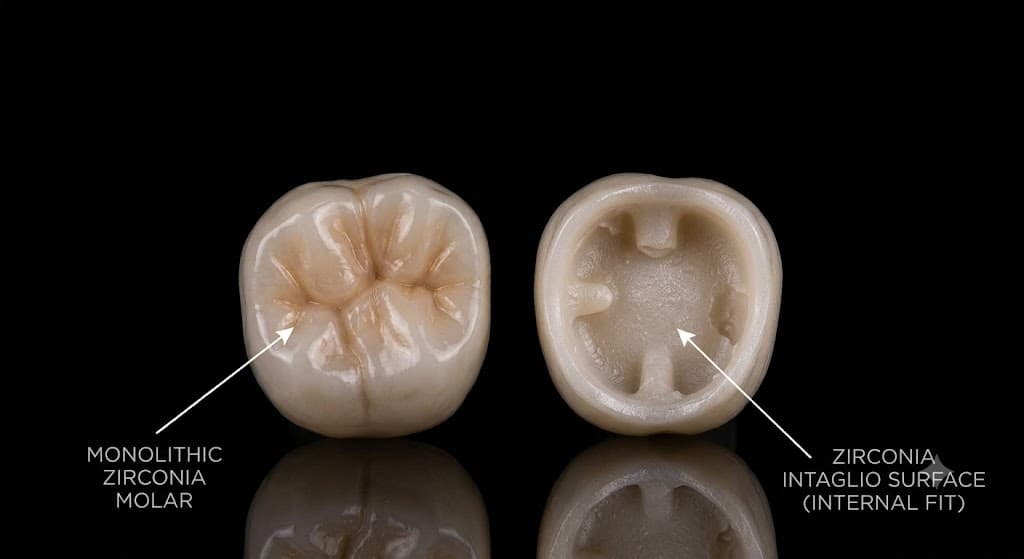
Zirconia crowns are milled from a solid block of zirconium dioxide — a high-strength dental ceramic — using CAD/CAM technology. They are entirely metal-free, making them the most biocompatible option available. Modern monolithic zirconia (a single solid block, no separate porcelain layer) is exceptionally strong — stronger than PFM porcelain — and has largely addressed the earlier concern about brittleness. High-translucency zirconia varieties closely mimic the natural appearance of enamel, making them an excellent choice for both front and back teeth.
Advantages
- No metal — completely biocompatible, ideal for patients with metal sensitivities
- No grey margin at the gumline — aesthetics remain excellent even if gums recede
- Monolithic zirconia is extremely strong — suitable for high-load posterior teeth
- High-translucency options closely match natural tooth colour and light transmission
- Smooth surface — less plaque accumulation than metal
- CAD/CAM milling ensures a precise fit
Points to note
- Higher cost than DMLS or PFM crowns
- Very hard material — can cause wear on opposing natural teeth in some cases (discuss with Dr. Meghana)
- High-translucency varieties, while aesthetic, are slightly less strong than standard zirconia
At a glance
| Type | Material | Aesthetics | Best for | Cost |
|---|---|---|---|---|
| DMLS Metal | Laser-sintered metal alloy | Not tooth-coloured | Posterior teeth, high-load cases | Moderate |
| PFM | Metal core + porcelain | Tooth-coloured (metal margin risk) | Front & back, budget-conscious | Moderate |
| Zirconia | Zirconium dioxide ceramic | Best — no metal margin | Front & back, metal-free cases | Higher |
Which should you choose?
The choice is clinical first, then personal
The crown material is not purely a cosmetic or budget decision — the location of the tooth, how much natural tooth remains, and how hard you bite all shape what material is the most appropriate choice.
For front teeth, aesthetics are paramount — zirconia is typically the best choice because there is no metal margin that could show at the gumline, and high-translucency zirconia closely resembles the natural look of enamel. PFM is also used for front teeth when a lower cost is a priority, though the risk of a visible grey margin over time should be discussed.
For back teeth (premolars and molars), the biting forces are significantly higher. DMLS metal crowns are an excellent choice here — they are the strongest option, and since the tooth is not visible when smiling, the metallic appearance is rarely a concern. Zirconia is also routinely used on back teeth for patients who prefer a metal-free mouth; monolithic zirconia is now strong enough to handle molar occlusal forces reliably.
Dr Meghana and team will evaluate the tooth, your bite, and your preferences and recommend the material that gives you the best long-term outcome — then walk you through the options so the final decision is always yours.
Not sure which crown is right for your tooth?
Book a consultation with Dr. P Meghana at The Tooth Stop, BTM Layout. We will evaluate your tooth, explain which material fits your case, and give you a clear cost estimate.